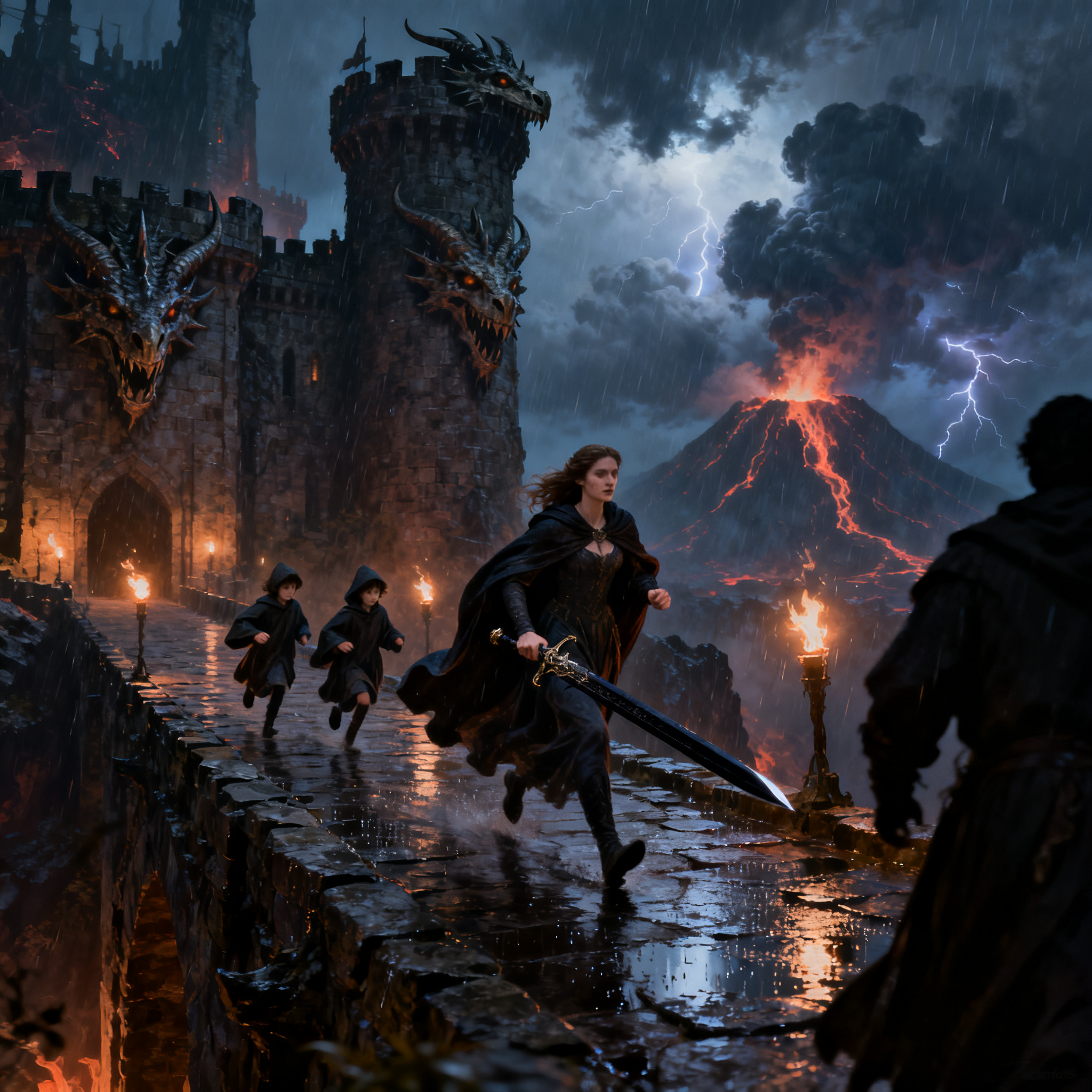
Dear friends, gather close, for tonight’s tale carries no dragons breaking chains, no burning letters, no dome collapsing in ruin. Tonight’s tale is quieter, and crueler for it — the story of a woman who buried two sons before she ever wore a crown, and was abandoned by the man she married before she buried herself.
A Queen Before She Wished to Be
Alyssa Velaryon was no stranger to the sea-lords of Driftmark before she was ever a queen. Daughter of Aethon Velaryon, Master of Ships, she wed Aenys Targaryen, the Conqueror’s own son, and gave him six children — Rhaena, Aegon, Viserys, Jaehaerys, Alysanne, and Vaella. When Aenys died in 42 AC, worn thin by a reign of rebellion and reproach, it was Alyssa who proclaimed their eldest son king. The realm knew him after as Aegon the Uncrowned, for he would reign only a matter of months before his uncle came to claim what he believed was his.
The Uncle Who Would Not Wait
Prince Maegor returned from Essos with sellswords and a dragon of his own, and declared himself king before Aegon could ever be crowned. War came to the Gods Eye, and there, above the water, Maegor rode Balerion the Black Dread into the sky and tore the wing from young Quicksilver’s back. Aegon fell with his dragon. He was the first son Alyssa lost, but not the last, and not the cruelest loss to come.
Hostage, and a Body Left in a Courtyard
With her eldest dead, Alyssa and her remaining children became Maegor’s hostages, held on Dragonstone to ensure no further rebellion rose in their name. Her son Viserys — now the eldest surviving — was taken and tortured for nine days. His mutilated body was left in the courtyard, a message meant to draw Alyssa from hiding. She did not come. Whatever it cost her to stay hidden, she paid it, and kept her two youngest — Jaehaerys and Alysanne, no more than children themselves — alive and unseen.
An Escape, and a Sword Not Her Own
Her chance came in 44 AC, when Dowager Queen Visenya died and the court’s grief turned to confusion. Alyssa took her two youngest and fled Dragonstone in that chaos — and took with her Dark Sister, Visenya’s own Valyrian blade, as though even in flight she meant to arm the children she had left. She rallied what lords she could to her son’s cause. Robar Baratheon, Lord of Storm’s End, answered. Maegor’s own reign would not long survive it — he was found dead upon the Iron Throne itself in 48 AC, by his own hand or another’s, a mystery the Citadel has never resolved to this day.
A Regency Shared, and a Second Marriage
Jaehaerys took the throne at fourteen, and his mother ruled beside him as Queen Regent, sharing power with Robar’s son, Rogar Baratheon, who served as Hand and Protector of the Realm. In time, regent married regent — Alyssa took Rogar as her second husband. It should have steadied the throne. Instead, it planted the seeds of the very rebellion Alyssa herself had once escaped: Rogar and Alyssa, now managing the young king’s future as much as the realm’s, proposed a Tyroshi bride for Jaehaerys, and betrothed Alysanne to Rogar’s own brother. The king and his sister, who loved each other as only Targaryens were permitted to, would not be so arranged. They wed each other in secret and returned to court already bound, leaving their regents no choice but to accept what could no longer be undone.
A Reconciliation, and a Death Alone
When Jaehaerys turned sixteen in 50 AC, his minority ended, and with it, his mother’s regency. He returned to King’s Landing and made his peace with her — whatever bitterness the arranged marriages had sown seems to have been forgiven, or at least set aside. It bought her only a year. In 51 AC, well past the age such things were expected, Alyssa found herself unexpectedly with child. Labor came a month early and nearly killed her outright. When Jaehaerys and Alysanne raced to Storm’s End to stand at her bedside, they found Rogar Baratheon drunk, unwilling to enter the room where his wife lay dying. Only sweetsleep eased her pain, the maester said, in the end.
Dear friends, there is no dragon in this story, no wax seal, no dome cracking open under the weight of fire. There is only a woman who outlived a husband, two sons, a captivity, an escape, a war, and a regency — and who died, in the end, waiting for a man who could not be bothered to walk through a door. Perhaps that is its own kind of dragon fire: the fire it takes to survive so much, only to be let down by so little.
Leave a Reply