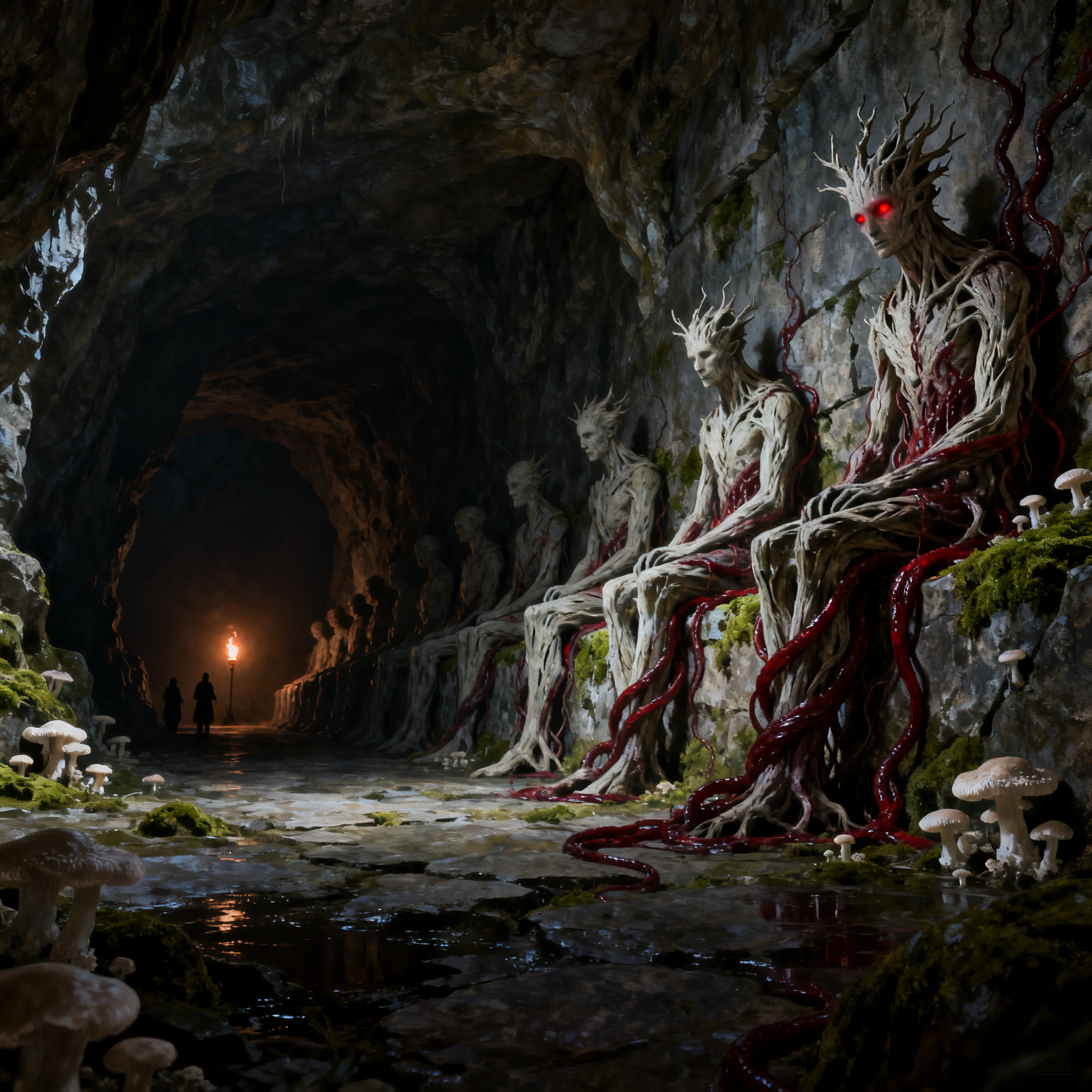
Beyond the Wall, in a cave tangled with roots, Bran Stark finds something the show never fully committed to showing us. Bloodraven isn’t alone down there. Rows of ancient singers of the forest sit enthroned in weirwood, roots grown through and around their bodies, most of them looking dead – until a torch passes and their eyes open to follow the light. It’s one of the most unsettling images in the books, and once you sit with it, it raises a question the story never answers directly: what if the Old Gods aren’t gods at all?
What Bran Actually Finds in the Cave
The Children of the Forest call themselves “those who sing the song of the earth” – singers, not children. The ones fused into the weirwood roots are greenseers, and according to Bloodraven, their mortal lives are short by design. What survives isn’t the body. It’s everything the greenseer ever knew – their memories, their magic, their voice – absorbed into the tree once the flesh gives out. The singers believe the weirwoods themselves are the Old Gods. And every greenseer who dies becomes part of that godhood.
Which means when Ned Stark kneels beneath Winterfell’s heart tree and prays, he isn’t praying to some detached deity. He’s praying into a network of dead minds – every greenseer who ever went into the wood, still listening, still remembering.
George Martin Has Told This Story Before
This isn’t the first hivemind-religion Martin has written. In 1976, years before Westeros existed, he published a science fiction novella called A Song for Lya. On the planet Shkea, the native Shkeen worship a parasite called the Greeshka. At forty, every Shkeen allows the Greeshka to infect them. At fifty, they undergo Final Union – they willingly let the parasite consume them, and it fills them with joy to die. The result is a mass-mind: “many in one, all love,” as one convert describes it.
The parallels to the weirwoods write themselves. Believers retreating into caves. A god that consumes its worshippers piece by piece. A collective consciousness formed from everyone who came before. The differences matter too – the Greeshka is a mindless parasite that needs the cult to keep feeding it, while a weirwood tree is alive on its own and actually sustains Bloodraven rather than draining him. But the shape of the idea is the same: Martin has always been interested in gods that are really just the sum of their believers’ surrendered minds.
The Logic That Turns Old Gods Into Greenseers
Here’s where the theory gets sharp. The singers believe the weirwoods are the Old Gods. Separately, we’re told that when greenseers die, they become part of that same godhood. If weirwood equals Old Gods, and greenseers also equal Old Gods, then weirwood and greenseer are the same thing wearing different names. The Old Gods aren’t a separate divine force watching over the North. They’re a repository of every greenseer who ever lived, still exerting will through the trees.
That reframes a lot of “religious” moments in the books as something closer to a very old, very patient magic system – one with its own agenda, whether or not the people praying to it know that.
Did the Children of the Forest Create the Others?
If greenseer magic built the Old Gods, the same magic might explain the Others. Westerosi legend already tells of the Children turning weirwood into warriors to fight the First Men – a folk tale so widespread even Asha Greyjoy grew up hearing a version of it on the Iron Islands. The show ran with a version of this outright: the Children created the Others out of desperation.
The more unsettling version of the theory goes further: since greenseers’ souls can apparently occupy other things – Bloodraven confirms dead greenseers live on inside the ravens in his cave – maybe they occupy the Others too. Each white walker, in this reading, carries the soul of a greenseer who never accepted the peace treaty signed on the Isle of Faces. The Children of the Forest as a people moved on. Some of their dead did not, and they’ve been waiting in the ice for the wildlings and the encroaching world of men to give them a reason to march again.
It would explain something the timeline otherwise struggles with: why an ancient threat would suddenly resume activity now, right as Mance Rayder unites the Free Folk and pushes them harder against the borders the Others have quietly held for millennia.
Is R’hllor Just the Old Gods in a Different Font?
The theory’s final turn is the boldest: that the Red God and the Old Gods are the same trick played twice. Both religions claim their god can detect a lie. Both practice a form of necromancy – R’hllor resurrects Beric Dondarrion, greenseer magic turns men into wights. Melisandre calls R’hllor the “God of Flame and Shadow” and insists shadows serve the light – yet the Others themselves are first described in the books as “a white shadow in the darkness.” Even the geography lines up: R’hllor worship and the Long Night both trace back east, to Essos, where black-barked, blue-leafed trees eerily similar to weirwoods still grow, and where a race very like the Children of the Forest may once have lived, before the land bridge that once connected the two continents sank beneath the sea.
If the theory holds, the visions driving Melisandre – and through her, Stannis, and through the Red Priests, Daenerys – aren’t the will of a god at all. They’re greenseer magic, dressed up in fire instead of leaves, quietly walking human armies north to their deaths.
Take It With a Grain of Weirwood Sap
None of this is confirmed – it’s a theory built from pattern-matching across Martin’s other work, a few loaded lines of dialogue, and the uncomfortable math of “weirwood equals Old Gods equals greenseer.” But that’s what makes it worth sitting with: A Song of Ice and Fire keeps insisting that sorcery is a sword without a hilt, that no one grips magic safely, not even – maybe especially not – the ones who think they’re praying to something divine. If the Old Gods really are just every dead greenseer who ever lived, still listening through the roots, then the North was never as quiet as it sounded.
Leave a Reply